Three techniques that can be used from the initial level
The examples are in English, but the logic is the same for German, Spanish or another foreign language. The important thing is that the child works with the words he already has, instead of immediately returning to Bulgarian.
1. Describe the function
If you don't know what the subject or profession is called, explain what it does.
- locksmith → “the person who opens locked doors and fixes locks”
- ladder → “the thing you climb on to reach something high”
This causes the child to use familiar vocabulary, verbs, and descriptions instead of waiting for a single word to "unlock" the sentence.
2. Give an example instead of a category
Sometimes the easier path to meaning is to name a few members of the group.
- spices → “salt, pepper, things like that”
- instruments → “piano, guitar, drums…”
The interlocutor usually understands the category and often gives the missing word himself. Thus, the new vocabulary comes inside a conversation in which it already makes sense.
3. Say the opposite
When an adjective is missing, the opposite meaning is often the shortest workaround.
- shallow → “not deep”
- cheap → “not expensive”
Here the child does not just recall vocabulary. He begins to see language as a system of relations between meanings and learns to be flexible with the means available.
One simple exercise: explain the word without saying it.
Descriptive speaking can be practiced quite directly. The child receives a word, object or picture and has the task of explaining it to others, without using the word itself and without translating into Bulgarian. Others must guess.
For younger children, the task can begin with very specific things — an animal, food, an object from the classroom. For older children, professions, places, actions and more abstract concepts can be included. The teacher can ask clarifying questions: "What does it do?", "Where do you find it?", "Is it big or small?", "Can you give me an example?"
The exercise looks like a game, but it trains exactly the moment that otherwise blocks the real conversation: I know what I want to say, but I don't know a word. Instead of a pause, action follows.
How does this relate to the Berlitz method?
In Berlitz, speaking is not left for the end of the lesson. The method works in the target language, presents the new content in context and goes through presentation, practice and independent application. In children's programs, speaking and real situations are part of the lessons from the beginning.
This means that when a word is missing, the teacher does not have to immediately interrupt the translation situation. Through questions, gestures, examples or reformulation, it can help the child to arrive at the meaning and stay in the target language. It is this logic that underpins the Berlitz method – language is used, not just explained.
Descriptive speaking is a natural test for such an approach. If the child is used to learning through communication, the missing word does not cancel the task. He is looking for another way to complete the message.
What does a child gain when the conversation does not stop?
The benefit is not limited to "getting better" in a particular situation. Descriptive speaking develops several habits that make language more practical.
- Focus on meaning. The child thinks "How can I be understood?" and not just "What is the right word?"
- More active use of the available vocabulary. Familiar words begin to be combined in new ways.
- Skill in correcting communication. If the first description is not clear, the child tries the second.
- A new word at the right time. The interlocutor often answers: "Oh, you mean a locksmith." Then the missing word comes already related to a specific idea and situation.
This is an important difference between passive recognition and active communication. A word may be familiar from the textbook, but the real skill is evident when the child manages to do without it.
What does this look like in a group
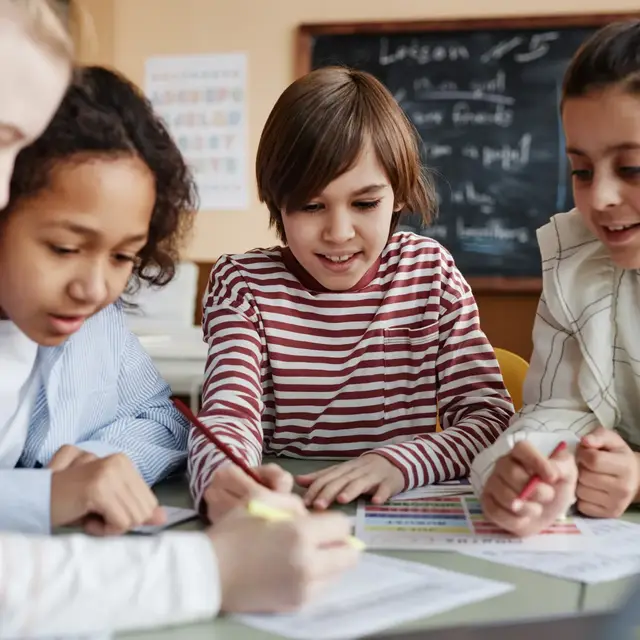
The group environment adds another useful element: different interlocutors. The same description can be understood immediately by one child and require more clarification for another. Thus, participants do not just repeat a pattern after the teacher, but learn to check whether their message actually works.
In group language courses for children, this practice has a natural social environment: children talk to each other, react, ask and look for a way to be understood. For children who have specific goals or feel more at ease in a 1:1 job, individual language lessons allow the same skill to be practiced with more personal focus.
How a parent can recognize learning that develops communication
When choosing a language course for a child, the helpful question is not just "How many words will he learn?". More important is what he will do with them.
- Does the child speak during the lesson itself, or does he mainly complete exercises?
- Are there tasks with a real purpose — to ask for something, to explain, to describe, to react?
- Does he get space to try a second way when the first one doesn't work?
- Does the teacher work with context and the target language, instead of solving every difficulty immediately with translation?
These details show whether the course only develops knowledge of the language or the ability to use the language.
Early language learning does not have to wait for "enough words"
It's easy to think of learning as an accumulation: first vocabulary, then grammar, and somewhere in the end, a conversation. In reality, communication can begin much earlier. A child can use short sentences, gestures, examples, and descriptions with a limited set of words.
That is why the ability to continue without the right word is such a good indicator of practical learning. It teaches the child that language is not a test in which every gap means a mistake. Language is a task: you have an idea and you have to find a way to convey it.
In Berlitz programs for children and teenagers, the focus is on active participation, real conversations and confident use of language. If the specific goal is English, you can also look at English programs for children.
_(1920_x_1005_px).png?auto=webp&format=webp&quality=70&width=500&height=500&fit=crop&crop=1280:500,smart)
_(1920_x_1005_px)_(1).png?auto=webp&format=webp&quality=70&width=1280&height=1280&fit=crop&crop=1280:750,smart)
_(11).png?auto=webp&format=webp&quality=70&width=640&height=640&fit=crop&crop=640:480,smart)